Light and power at the bedside
A socket in a headboard removes the cable across the floor. What it does not remove is the reason the cable was there, and public health guidance is blunt about the device at the end of it.
What a built-in charging station replaces and what it cannot do
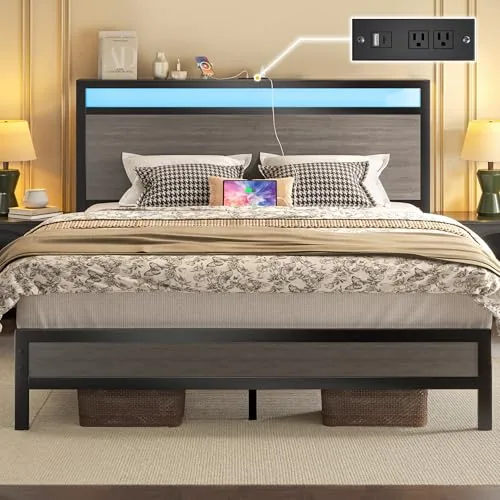
A built-in charging station can replace one small item on a bedside table: a separate charging adapter, cable, or power strip that might otherwise sit beside the bed. It gives a phone or another compatible device a fixed place to connect. That can make the bedside feel more settled, particularly when the nearest wall outlet is behind the frame or difficult to reach.
It does not replace the wall outlet. The station needs a connection to household power, and that connection still has to reach an outlet safely. It does not create power where none is available. It also does not turn every charging port into a universal power source. The device, cable, port, and electrical connection all need to be compatible.
We see a charging station as a convenience built into the frame. It may help keep a phone within reach overnight or provide a place to recharge a small personal device during the day. It is not a substitute for a full electrical installation. It should not be treated as one.
The practical boundary is simple:
| A bedside charging station can do | A bedside charging station does not automatically do |
|---|---|
| Provide a dedicated place to connect a compatible phone or small rechargeable device | Power any device without confirming the port, cable, and output are compatible |
| Reduce the need for a separate adapter or power strip on the nightstand | Replace the wall outlet or create an independent source of electricity |
| Keep a charging connection near the bed | Charge a device faster than its connection and power rating allow |
| Help keep one cable in a known location | Safely support high-draw appliances such as heaters or hair dryers |
| Make a frame more convenient for a device used at the bedside | Guarantee that every charging cable will fit or work |
Before ordering, treat the phrase “charging station” as a starting point rather than a complete specification. Check the product details for the type of connection, the station’s location on the frame, and any stated output information. If those details are not shown, do not assume them.
A built-in charging point can change how you use the bedside. If your phone has a fixed home beside the bed, it is less likely to end up on the floor or behind a pillow. That is a small practical gain. It can also reduce loose cable movement across the tabletop, leaving the nightstand easier to use.
There is a tradeoff. The charging point stays with the frame. If you move the bed, rearrange the room, or use the frame in another space, the cable route may need to change. The position of the port matters too. A port near the headboard may be convenient from the pillow but less useful if you prefer to keep devices on a nightstand.
Our range includes 46 bed frames and bedside pieces across five departments: King, Queen, Full, Twin, and Nightstands. Twenty-eight products have a built-in charging station. That gives you a useful comparison point. A charging station is one feature among several. It should not distract from the frame’s size, layout, storage, or other stated details.
LED lighting on a frame: where it helps and where it is decoration
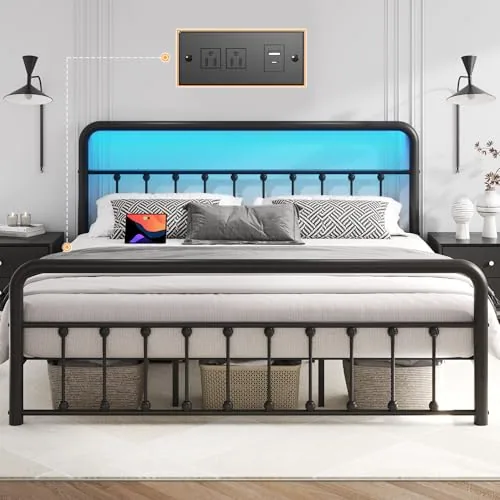
LED lighting can serve a practical purpose near the bed. A low light along the base or headboard may help you see the edge of the frame, find a dropped item, or move around the room without switching on the main light. Light near the headboard can also make a reading area feel more defined, although you should confirm the control location and lighting position before ordering.
Its usefulness depends on placement. Light close to the floor may help with orientation when you get up. Light placed behind or around a headboard may be more visible than useful, especially if the bed sits close to a wall. A visible glow can still be part of the room’s look. In that case, it is decoration rather than task lighting.
The same feature can work differently in different rooms. In a dark bedroom, a small amount of light may help you navigate. In a room with other lights, it may add visual interest without solving a specific problem. If you already use a lamp or wall light, frame lighting may be an optional design detail.
We count 28 products in the FLUEST range with LED lighting. Those products are not automatically interchangeable. The product details should tell you where the lighting sits and how it is controlled. Look for information about the control method, the light location, and the cable path. If a detail is not stated, leave room for uncertainty.
LED lighting needs a clear role. Decide what you want it to do before choosing a frame:
- Help you see the floor when getting up
- Add a soft glow around the bed
- Mark the edge of the frame in a dark room
- Provide a decorative feature that can be switched on when wanted
These uses are different. A light designed to glow around the frame may not be bright enough to read by. A light intended for atmosphere may be distracting if it remains visible from the pillow. If you are sensitive to light while sleeping, check whether the product information explains how the lighting is switched off.
Think about the control before you place the frame. A light that is easy to switch off from the bed may fit a different routine than one that requires you to reach behind the headboard. The control location can affect how often you use the feature. It can also affect whether you leave the light on simply because turning it off is inconvenient.
A lighted frame can draw attention to the area around it. Loose cables, dust, or items stored under the bed may become more noticeable. That is not a reason to avoid the feature. It is a reason to plan the space around it. Keep the floor area clear if you want the light to read as a deliberate part of the room.
The honest counterpoint from public health guidance on devices before bed
A charging station makes it easier to keep a device near you. That convenience can work against a good bedtime routine if the phone remains active, bright, or tempting to use. The presence of a charging point does not make late-night screen use a good idea.
The Centers for Disease Control and Prevention, in About Sleep, recommends, “Turning off electronic devices at least 30 minutes before bedtime.” That advice concerns the routine around sleep, not the quality of a particular bed frame. A built-in charging station can support the routine if you use it as a place to put the phone away before that 30-minute period begins.
It can also work the other way. If the phone stays within easy reach, it may be harder to stop checking messages, scrolling, or responding to alerts. A charging station solves a cable problem. It does not solve the habit of using the device.
The National Heart, Lung, and Blood Institute, in Sleep Deprivation and Deficiency, defines the broader concern clearly: “Sleep deprivation is a condition that occurs if you don't get enough sleep.” The issue is not limited to one night or one device. A bedside arrangement should support the amount of sleep you need rather than make interruptions easier.
The same National Heart, Lung, and Blood Institute guidance adds, “Sleep deficiency can interfere with work, school, driving, and social functioning.” We include that counterpoint because a feature guide should not present power and light as automatic improvements. A device kept close to the pillow may be convenient, but convenience has a boundary.
A sensible setup can preserve the charging benefit while reducing temptation:
- Put the phone on charge before starting your wind-down period.
- Turn off unnecessary alerts.
- Use a clock if you do not need the phone for timekeeping.
- Keep the screen facing away from the pillow.
- Place the device on a nightstand or charging shelf instead of in the bed.
These steps do not require a particular frame. They can work with a charging headboard, a standard nightstand, or a simple outlet near the bed. The frame feature should support your routine rather than determine it.
LED lighting deserves the same honest treatment. A soft, low-positioned light may help with a nighttime trip across the room. A bright or visible light may be distracting for some people. If you want the room dark, switch the lighting off before sleep and check how easily that can be done from the controls provided.
Cable management and why a socket behind a bed is the real problem
A cable is only tidy when its full route is tidy. The visible part on the nightstand may look organized while the section behind the bed is bent, trapped, or stretched. That hidden section deserves attention before the frame is placed.
A wall socket behind a bed is often the main source of difficulty. The frame can press against the plug. The cable may be forced into a sharp bend. Reaching the outlet may require moving the bed, and moving the bed may pull on the connection. A charging station does not remove this issue. It changes where the connection appears at the bedside, but power still has to travel from the wall.
Before ordering, identify the outlet’s position in relation to the headboard and side rails. Measure the distance from the outlet to the point where the frame’s power cable will enter. Consider the route around the side of the bed if the outlet is blocked. A cable should not be stretched across a walking path or squeezed between the frame and the wall.
Leave enough room to inspect the connection. A plug that cannot be seen is harder to unplug, clean around, or notice if it has shifted. The frame should not rest on the cable. The cable should not run beneath a part that moves or bears weight.
Keep the route simple. A cable that travels along the back of the headboard may be easier to manage than one that crosses the floor. If it must travel near the floor, keep it close to the wall and away from the side where people walk. Do not rely on the mattress or bedding to hold it in place.
The product details may show the charging station’s position, but they may not answer every room-specific question. Think about the placement of your own outlet, the room’s traffic pattern, and the direction in which the bed will face. A feature that is convenient on the left side may be less convenient if your outlet is on the right.
A nightstand can help hide and organize the visible cable, but it should not trap the connection. Keep a little slack at the point where the cable meets the frame. Too little slack can pull on the connection when the bed or nightstand shifts. Too much slack can create a loop that catches on nearby objects.
Avoid running a cable under a rug, beneath bedding on the floor, or through a place where furniture legs can press on it. Do not use a damaged cable. If an adapter or connection becomes hot, smells unusual, or shows visible damage, unplug it and stop using it.
The built-in station also needs a realistic load. Use it for compatible personal devices as described in the product details. Do not connect high-draw appliances simply because the port is nearby. A bedside charging point is not a general-purpose replacement for every outlet in the room.
What to check on a charging headboard before ordering
Start with the connection itself. Check what type of charging port or power connection is stated. Do not assume that a product described as having a charging station includes every cable or adapter you use. The device you plan to charge should match the connection provided.
Next, check the location. A port built into the headboard may sit near one side, near the center, or at another stated position. Think about where you sleep, where you keep your phone, and whether a nightstand will cover the port. If two people will use the bed, confirm that the layout makes sense for both sides.
Look for information about the number of ports. One charging point may be enough for one phone. It may be less convenient if two people need to charge devices at the same time. Do not infer the number from an image alone. Use the written product details.
Check the stated output information if it is provided. Output affects charging behavior, but the device and cable matter too. A port may connect successfully without delivering the speed you expect. If a specific charging standard is important to you, look for that standard in the product information rather than assuming it.
Consider access while the bed is made. A cable connection that is easy to reach from a bare mattress may become awkward with pillows, blankets, or a headboard cushion in place. Think about whether you want to use the port while lying down or only before sleep.
Review the frame’s other stated features at the same time. In our range, 38 of the 46 bed frames and bedside pieces carry storage. Twenty-eight have a built-in charging station, and 28 have LED lighting. These counts overlap. A frame with charging may also have storage or lighting, but the counts do not mean every feature appears on every product.
Headboard type may affect how the charging point feels in daily use. We count 43 products with a headboard. We build 21 of them with upholstery and 14 in bare metal. Those categories overlap with the other feature counts, so compare the specific product details rather than relying on the category alone.
Size matters. Our departments cover King, Queen, Full, Twin, and Nightstands. Choose the department that matches your mattress and room plan. A charging feature cannot correct a size mismatch. If the frame will sit in a tight room, consider the space needed to reach the outlet and access the side of the bed.
Color is a visual decision, but it can affect how visible cables and lighting appear. The colors in our range are black, grey, beige, white, retro brown, rustic grey, and antique white. A darker frame may make a loose cable less noticeable in some rooms. A lighter frame may make the surrounding area feel brighter. The cable route still matters regardless of color.
A routine for a bedside that stays tidy
Begin with one clear home for each item. The phone goes on the charging point or in a defined spot on the nightstand. The charging cable stays connected only if that arrangement works for the room. Glasses, a book, and other nighttime essentials should have places that do not overlap the cable route.
Keep the surface useful rather than crowded. A bedside does not need to hold every item you might use during the day. Move receipts, packaging, spare cables, and unused accessories elsewhere. The less that surrounds the charging point, the easier it is to notice a loose connection or clean the surface.
Choose one main charging cable for the bedside. Extra cables can stay in a drawer or another designated place. If you need different connections, label or separate them so you do not pull several cables across the same area. A cable that is easy to identify is less likely to be left in the wrong place.
Set a charging time. Connect the device before your wind-down routine, then stop using it at the point you have chosen. If you follow the Centers for Disease Control and Prevention guidance to turn off electronic devices at least 30 minutes before bedtime, the charging station can mark the start of that period.
Keep the phone out of the bed. A built-in station may be close enough to reach, but it does not need to be under the covers or beside your pillow. Place it where the screen is less visible. This makes the charging point useful without making the device the center of the bedtime routine.
Use LED lighting deliberately. Turn it on when you need help finding your way, then switch it off when you are settled. If the lighting is mainly decorative, decide when you want it visible. Avoid leaving it on simply because it is available.
Once a week, look behind the frame. Check that the cable has not shifted into a pinch point, that the plug remains accessible, and that nothing has been placed against the connection. This takes less time than moving the bed after a problem develops.
Use the storage feature for items that otherwise gather around the charger. In our range, 38 products carry storage. That can give bedding accessories, books, or personal items a defined place, but storage works best when you assign it a purpose. Do not fill every compartment simply because it is there.
Match the routine to the frame. An all-metal frame, an upholstered frame, a headboard, a nightstand, and an LED feature may create different surfaces and access points. Review the product details before deciding where your cable and everyday items will go.
Sources
- About Sleep, Centers for Disease Control and Prevention. Read 14 August 2026. How much sleep each age group needs, what counts as good quality sleep, and the habits that affect it.
- Sleep Deprivation and Deficiency, National Heart, Lung, and Blood Institute. Read 14 August 2026. How sleep deprivation differs from sleep deficiency, and what each one affects.
Nothing on this page is medical advice. Where a public authority is quoted, the quotation is word for word and the link goes to the page we read.